


представяне на продукта
| 3-Cyanopyridine Basic information |
| 3-Cyanopyridine | |
| NICOTINIC ACID NITRILE;NICOTINONITRILE;NICOTINE ACID NITRILE;SPECS AC-907/25014098;TIMTEC-BB SBB007554;IFLAB-BB F2108-0102;BETA-CYANOPYRIDINE;3-Azabenzonitrile | |
| 100-54-9 | |
| C6H4N2 | |
| 104.11 | |
| 202-863-0 | |
| Pharmaceutical intermediates;Pyridines derivates;Heterocyclic Compounds;bc0001 | |
| 100-54-9.mol | |
 |
|
| 3-Cyanopyridine Chemical Properties |
| 48-52 degree (lit.) | |
| 201 degree (lit.) | |
| 1.159 | |
| 1.5242 (estimate) | |
| 184 degree F | |
| 140g/l | |
| pK1:1.45(+1) (25 degree ) | |
| 140 g/L (20 ºC) | |
| 107711 | |
| NIOSH: IDLH 25 mg/m3 | |
| GZPHSAQLYPIAIN-UHFFFAOYSA-N | |
| 100-54-9(CAS DataBase Reference) | |
| 3-Pyridinecarbonitrile(100-54-9) | |
| 3-Pyridinecarbonitrile (100-54-9) |
| 22-36/37/38 | |
| 22-24/25-36/37/39-26 | |
| 3 | |
| QT3030000 | |
| 29333999 | |
| 100-54-9(Hazardous Substances Data) |
| 3-Cyanopyridine | |
| 3-Cyanopyridine Usage And Synthesis |
| The cyanopyridines are as follows: 2-cyano-: A white to tan liquid or solid. Almond odor. Boiling point=2213 degree ; freezing/melting point=27 degree ; flash point=89 degree . 3-cyano-: a colorless liquid or gray crystal- line solid. | |
| 3-Cyanopyridine is used in the preparation of arylthiazolines and arylimidazolines via dibromodimethylhydantoin-catalyzed condensation of aryl nitriles with ethylene diamine or aminoethanethiol. | |
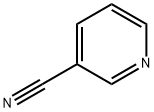
| ChEBI: A nitrile that is pyridine substituted by a cyano group at position 3. | |
| Tetrahedron Letters, 29, p. 2155, 1988 10.1016/S0040-4039(00)86697-6 | |
| Limits in Air NIOSH IDLH525 mg/m3 NIOSH REL: (nitriles) 2 ppm, Ceiling Concentration, not to be exceeded in any 15-minute work period. | |
| UN3276 Nitriles, liquid, toxic, n.o.s., Hazard Class: 6.1; Labels: 6.1-Poisonous materials, Technical Name Required, Potential Inhalation Hazard (Special Provision 5). | |
| It is recrystallised to constant melting point from o-xylene/hexane. [Beilstein 22/2 V 115.] | |
| Oxidizing agents, such as perchlorates, peroxides, and permanganates. Nitriles may polymerize in the presence of metals and some metal compounds. They are incompatible with acids; mixing nitriles with strong oxidizing acids can lead to extremely violent reactions. Nitriles are generally incompatible with other oxidizing agents such as peroxides and epoxides. The combination of bases and nitriles can produce hydrogen cyanide. Nitriles are hydrolyzed in both aqueous acid and base to give car- boxylic acids (or salts of carboxylic acids). These reactions generate heat. Peroxides convert nitriles to amides. Nitriles can react vigorously with reducing agents. Acetonitrile and propionitrile are soluble in water, but nitriles higher than propionitrile have low aqueous solubility. They are also insoluble in aqueous acids . |
| 3-Cyanopyridine Preparation Products And Raw materials |
| 4-Chlorobenzaldehyde-->Nicotinamide-->N-PHENYL-1-NAPHTHYLAMINE HYDROBROMIDE | |
| Nicotinic acid-->Nicotinamide-->3-(AMINOMETHYL)PYRIDINE-->2-(3-PYRIDYL)-1,3-THIAZOLE-4-CARBOXYLIC ACID-->2-chloro-5-cyanopyridine-->3-Pyridinecarboxaldehyde-->2-(2-PYRIDINYL)-4-(TRIFLUOROMETHYL)-5-PYRIMIDINECARBOXYLIC ACID-->3-AMINOMETHYL-PYRIDINE-2-CARBOXYLIC ACID-->3-AMIDINOPYRIDINIUM CHLORIDE-->ETHYL 4-(TRIFLUOROMETHYL)-2-(PYRIDIN-2-YL)PYRIMIDINE-5-CARBOXYLATE-->3-(TERT-BUTOXYCARBONYLAMINO-METHYL)-PYRIDINE-2-CARBOXYLIC ACID-->3,3'-DIPICOLYLAMINE-->3-PYRIDINECARBOXAMIDINE-->3-CYANOPYRIDIN-4-YLBORONIC ACID-->3-[(N-(TERT-BUTYLOXYCARBONYL)AMINO)METHYL]PYRIDINE-->3-(Aminomethyl)pyridine-->3-PYRIDYLAMIDOXIME-->Methyl 2-(3-cyanopyridin-4-yl)acetate-->3-Pyridinemethanol--> |
Популярни тагове: 3-cyanopyridine, China 3-cyanopyridine manufacturers, suppliers, factory
Един чифт: 2-Хлороникотинова киселина
Следваща: 3-Пиколин
Може да харесаш също


Изпрати запитване
